
A Splitboard guide is more than just someone who sets the track. They stand for quality, experience, and a sense of responsibility – for a safe, intense, and inspiring experience in the mountains.
At Radical, we work exclusively with certified Splitboard guides. They don't just bring the necessary expertise and experience, but also share our attitude: safety, respect, and the joy of being out there together are at the center of everything.
The Guide - Quality, Competence, Responsibility
For us, it's not about exclusion, but about exchange. Everyone who is out with groups in winter – whether mountain guides, snow sports instructors, J+S leaders, or SAC guides – carries responsibility and contributes to a vibrant mountain culture. When information is shared instead of being lost, everyone benefits: nature, the providers, and above all, the guests.
Focus on the Guest
The central question of every tour is: What does my guest want – and what are they capable of?
A freerider looks for different lines than a classic tourer. A beginner wants safety and confidence, an experienced Rider wants challenge and flow. Good guides sense these differences and design the tour accordingly. That makes the difference between a tour and an experience.
Safety as a Core Value
Safety isn't a side issue; it's the foundation of every tour.
Mountain sports always involve risks – that's part of the fascination. A good guide recognizes dangers early, makes clear decisions, and ensures that the joy remains the priority. Experience, knowledge, and composure are crucial here.
Quality Creates Trust
A certified Splitboard guide stands for professionalism. This also includes liability insurance, which offers protection in an emergency – an aspect many underestimate. Commercial offers without official authorization are not only legally tricky but also a risk for guests who may be giving up insurance coverage.
Differences Between Splitboarding and Ski Touring?
Splitboarders approach their tours differently than classic ski tourers. They often choose a slightly wider, more even track on the ascent with fewer kick turns. On the descent, they look for lines with lots of flow and room for turns, while ski tourers sometimes ride more directly or technically. Splitboarders prefer slopes with a high fun factor, powder, and descents that are worth the effort. Flat passages are avoided whenever possible because you can't just pole out like you can on skis. That's why we offer special tours tailored exactly to these needs.
Standards, Level, and Experience
Every tour is individual – just like the people taking part.
What is exhausting for one person is a relaxed warm-up for another. The key lies in hitting the right level and leading the group to the destination safely, motivated, and with joy.
A Splitboard guide is therefore much more than a tour leader. They are a coach, safety manager, route planner, and motivator all in one – in short: a quality product.
The central questions for every tour leader, whether mountain guide, snow sports instructor, J+S leader, or SAC guide, are: What does my customer want?
The Guide - A Quality Product
In this blog, we don't want to determine a winner, but rather explain the nuances of different types of guiding and offer solutions at the same time.
Every certified tour leader has their own quirks when guiding. But they all certainly have one thing in common: safety while touring. Mountain sports are dangerous and always involve risks. Avalanche danger is just one of many hazards. The idea of good risk management is to identify, structure, and quantify individual risks and estimate the overall risk – which, of course, can never be reduced to zero. The goal is a conscious approach to the biggest risks. On a ski or snowboard tour, various considerations, measures, and activities are constantly required. This takes knowledge and experience – everything a good guide should bring to the table. It's great if the sustainability, character, and financing also fit. However, the price of a tour should never be the primary focus.
A certified guide has liability insurance that, in the worst case, covers the customers' claims. Offering commercial tours without professional authorization is illegal, and this insurance coverage is also missing. In addition to a potentially tragic accident, customers are often left with a financial disadvantage.
When offering tours for the desired target group, the requirements for such a tour always arise. What is difficult for one person is easy for another to master. There are two important points that are also safety-relevant:
The difficulty of a tour and the physical requirements.
The physical requirements refer to your endurance, while the technical riding requirements concern your board control. We have summarized this on our site in text and video. —> Tour Requirements
Back to the initial question: What does my customer want? You have to ask yourself what fits you. Every tour provider addresses their clientele the way they want to. We, at Radical, address splitboarders. Our certified guides are splitboarders themselves. For legal reasons alone, we do not offer glacier tours. We offer pleasure tours with plenty of vertical meters of descent, sustainable and personal. But what is the difference on tours with ski tourers?
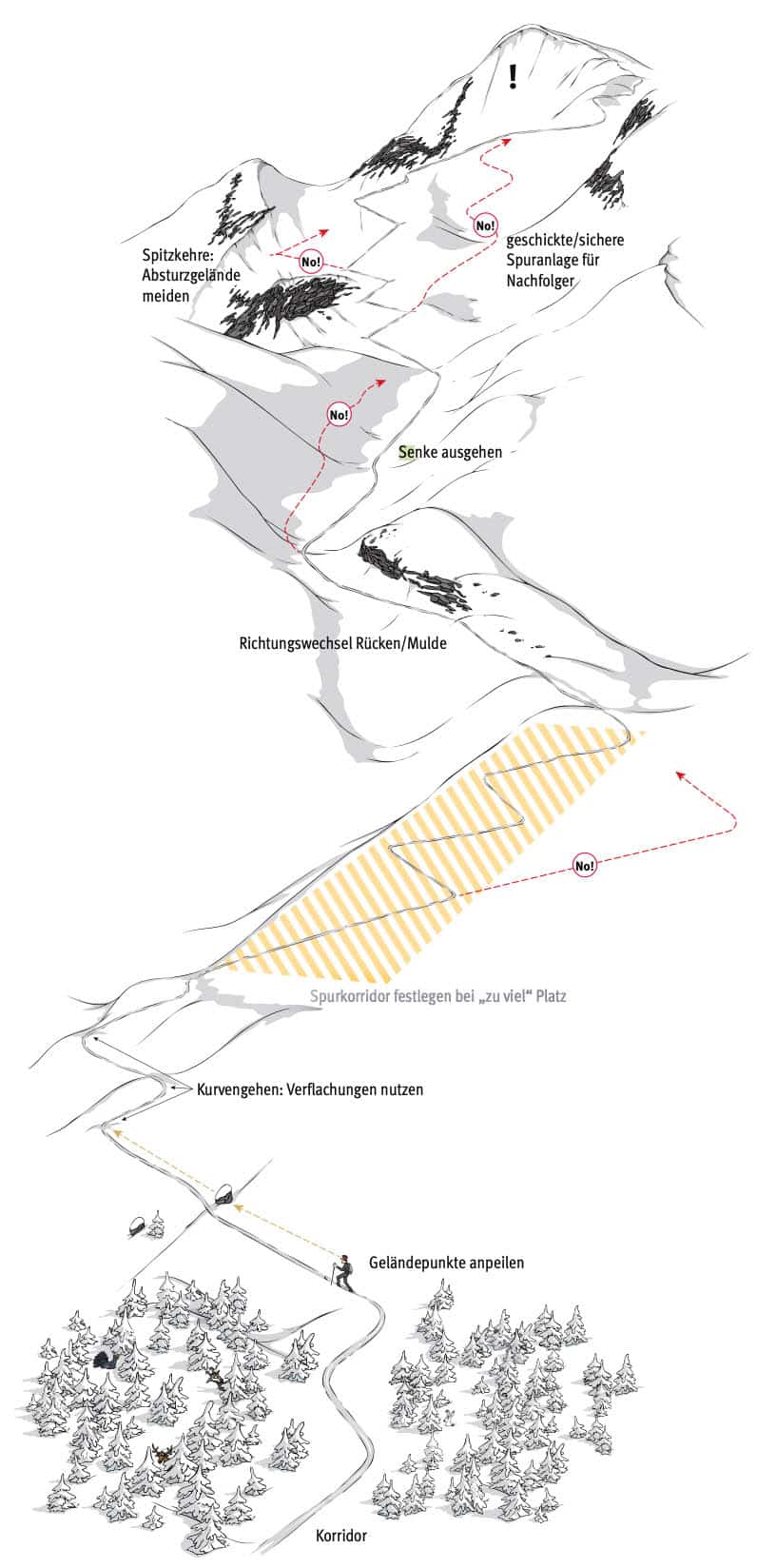
Steepness is relative. A track that is too steep remains exhausting, even if it is consistent. Even less favorable is a change between flat and steep passages – this breaks the rhythm and costs energy.
A good guideline for the right incline is your legs: if you have to push hard from your thighs with every step and your calves are constantly under tension, the track is too steep. Even a high heel lift will hardly bring relief then.
If the track is laid out moderately, it's smoother to walk. A steady rhythm is easier to establish – crucial for endurance and efficiency on longer ascents.
Choose terrain points so that the ascent line remains as constant as possible. Recognizing and adjusting steeper sections early saves strength.
High heel lifts offer only limited advantages: they make balance more difficult, shorten the stride length, and make flat sections tedious. In addition, the pressure shifts to the forefoot, which encourages slipping.
The track width also counts: a track slightly narrower than hip-width is usually ideal – tracks that are too narrow, on the other hand, are simply tedious, as we splitboarders know.
Track layout.
For a tour leader, there is hardly a better business card than a perfectly laid track, where safety and enjoyment are optimally considered and the terrain is used in the best possible way.
What is the legal situation?
In principle, anyone is allowed to lead tours as long as it is not commercial. For guided tours with a financial background, there are clear regulations.
Tours, whether in summer or winter, may not be led commercially by just anyone, but only by persons who have completed appropriate training.
--> Mountain Guide
The mountain guide has completed specialist training according to the Swiss Mountain Guide Association (SBV). This is the highest qualification for leading ski tours, even in difficult terrain. They are legitimized by an ID card and a badge from the International Federation of Mountain Guides Associations (IFMGA).
--> Snow Sports Instructor or Ski Guide
Snow sports instructors with risk licensing are entitled to lead ski tours with a difficulty level of at most WS (Little Difficult) for tours and S (Difficult) for off-piste descents.
--> J+S Leader / SAC Leader
Instructors for high-altitude ski tours may lead members of alpine clubs on high-altitude ski tours (crossing glaciers and short summit climbs on rock). The training is only accessible to people who work voluntarily in clubs, schools, or other non-profit organizations. These persons are not entitled to lead for gainful employment.
--> Ski and Snowboard Instruction with or without training
May only teach or conduct courses within the area of responsibility of ski lift and cable car operators.
Risk while touring?
Ski and Splitboard tours in open terrain are at your own risk. Liability claims of any kind against Radical or the authors are excluded. Navigating routes requires good physical condition, serious preparation, and technical knowledge of mountain sports. For safe mountain sports, Radical Sports recommends training under expert guidance or guided tours.
Wildlife in winter?
Winter rest - this is the most important factor for wildlife in winter. Our native animal species have adapted to the harsh winter days. Changing fur, lowering body temperature, adapting to food shortages, and passive warming in the sun are just a few survival strategies. Disturbances in their habitats can quickly decide between life and death. Therefore, respect your limits!
More info at: Swiss Wildlife Quiet Zones (wildruhezonen.ch)
Insured while touring?
Activities offered commercially are subject to a licensing requirement. Providers act commercially if they generate a primary or secondary income in Switzerland with activities subject to licensing. The cantons are entrusted with enforcement.
The leader according to RiskG must have professional liability insurance covered for 5 million. If an accident happens despite careful planning and safety measures and consequential damage occurs, both the guests and the guide are covered. Unlicensed guides do not have this insurance!
Problems and Solutions
Something can always go wrong. It's important to know what, why, and how to fix it. There are, of course, differences between splitboarders and ski tourers.
Problem:
Walking with Splitboard gear works reliably but is heavier in weight than the average ski touring equipment.
Solution:
More time is needed and endurance is challenged. Handing over gear can help. Lighter equipment, of course, too.
Problem:
Splitboard bindings have many moving parts. Parts that can break or fall off. A loss can lead to big problems.
Solution:
Carry spare parts. Check equipment before the tour. Apply Loctite (special threadlocker) to all screws.
Problem:
Traverses and flat sections can be overcome more easily by skiers than by snowboarders. Getting stuck in flat sections is exhausting and tedious.
Solution:
Avoid traverses and flat sections, announce them early enough, and approach them from higher up. Get poles ready in good time. Skiers are allowed to help with pulling and standing up. More time is needed and endurance is challenged.
Problem:
Starting off in deep snow on flat sections is hardly possible for snowboarders. The same applies to standing up.
Solution:
Stop on clear knolls so that the snowboarder can start off more easily. Clear and early communication about where and when the meeting point is.
Quirks of Touring - Skiers and Splitboarders
Flat Sections
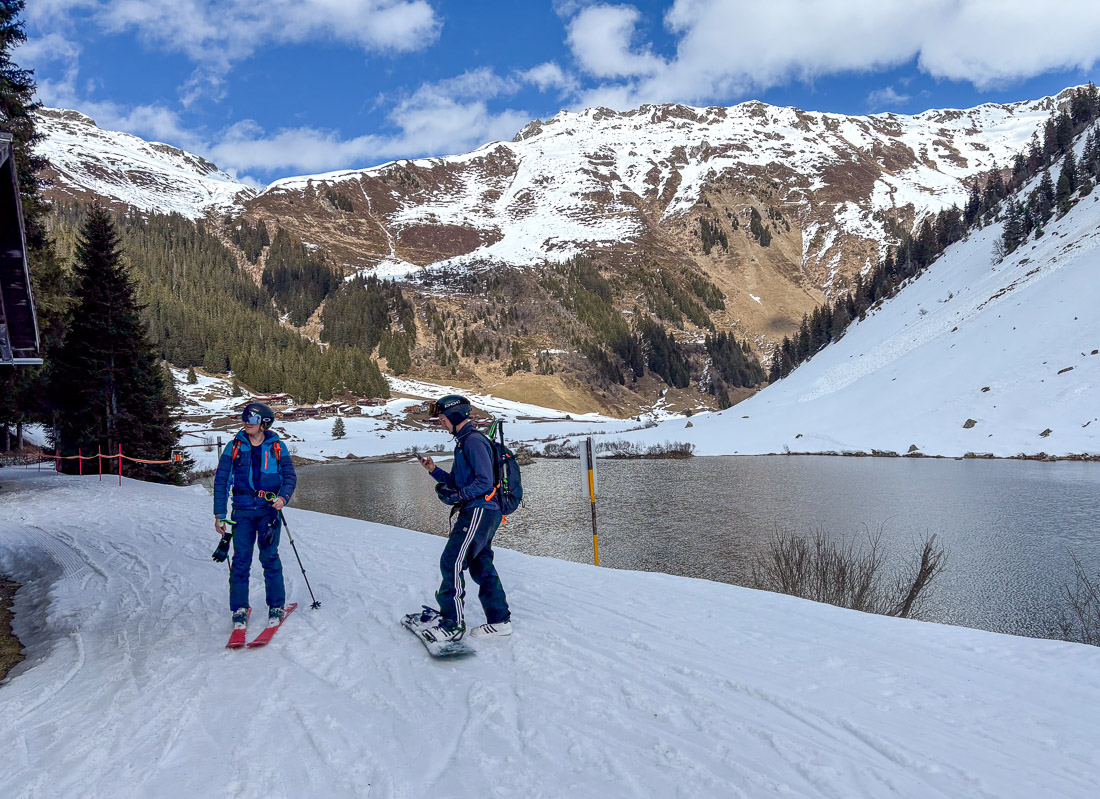
Flat sections are tedious for everyone. For snowboarders, even more so. Since boarders have a sideways and fixed stance, pushing with poles is also very exhausting. Even small counter-climbs cost strength and time. In fresh snow or karst areas, it's a nightmare. Depending on the passage, it's even worth putting skins back on, as walking takes more strength and time. With a Splitboard, you are therefore significantly less flexible and often have to switch modes in an emergency.
Traverses
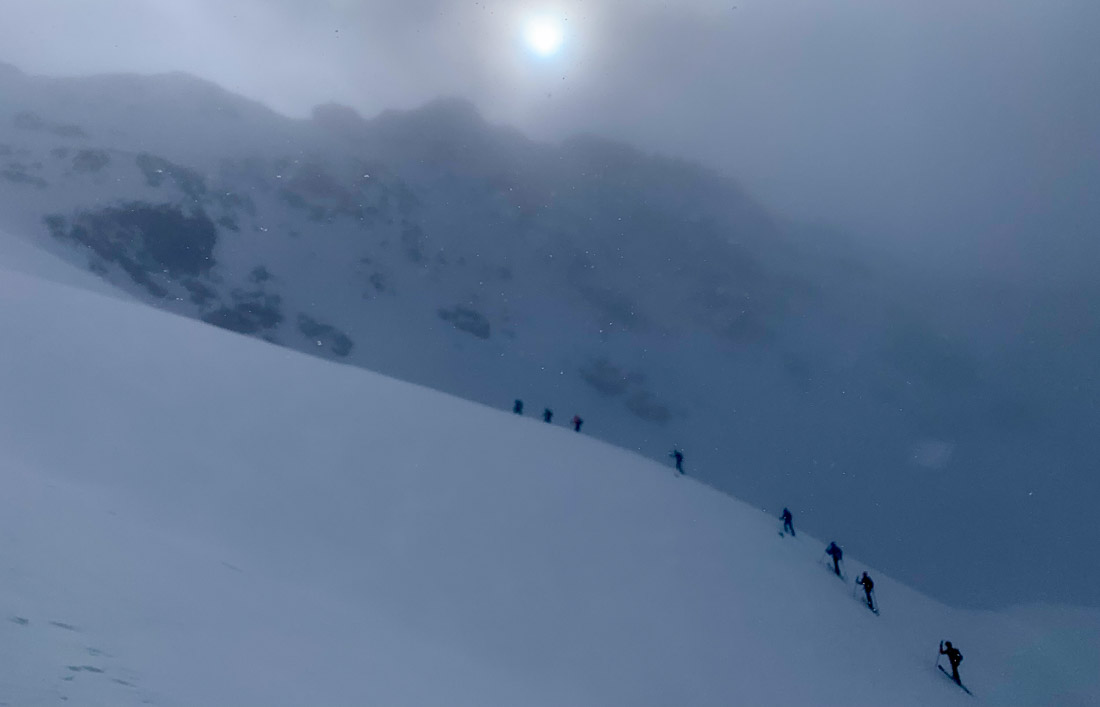
Long traverses cost strength. On the ascent, because the splitboarder's ski is usually wider and the lateral stability is less than for ski tourers.
On the descent, it depends on the foot position. On the backside edge, the calves burn after a short time. On the frontside, it's the shin muscles. Switching to riding switch is mostly not an option.
Walking Passages
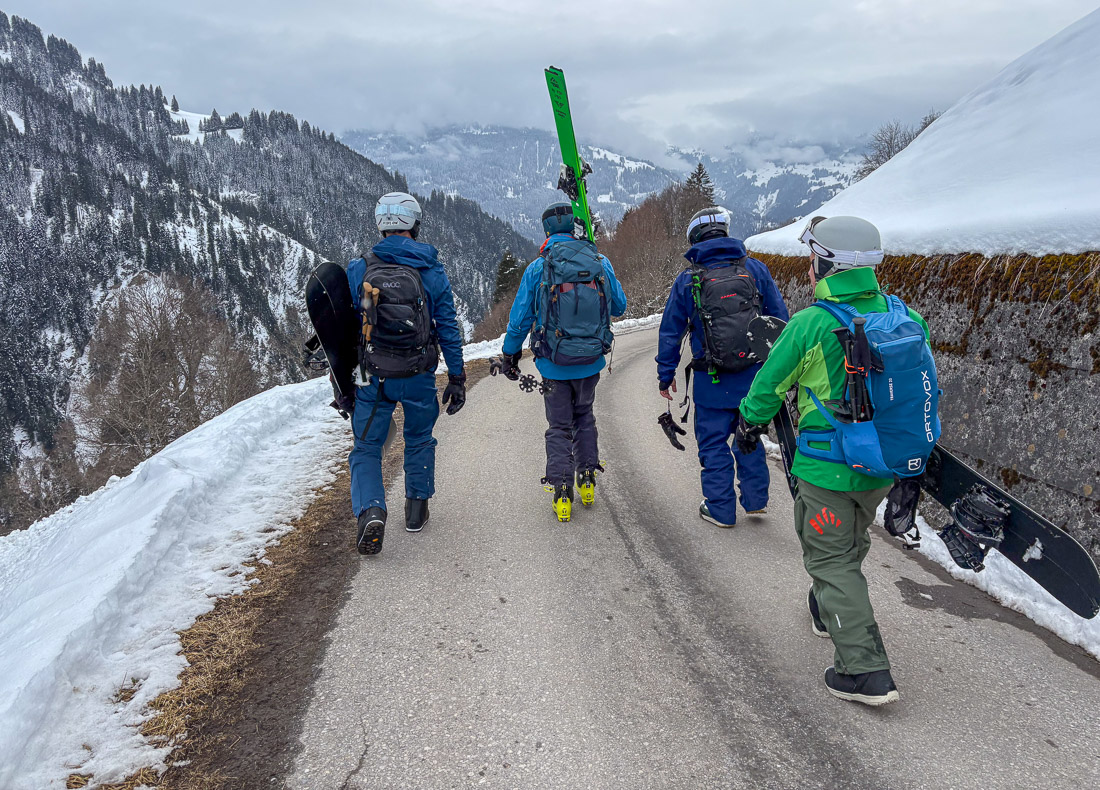
Walking in snowboard boots is generally very comfortable. The soft sole and the softer boot are ideal for walking longer distances on asphalt or hard snow. One of the big advantages of snowboard boots. On ice and rock, touring ski boots are better suited as they have a harder sole. Don't forget to set the walk mode.
You also have to be aware that splitboarding takes about 20 to 30 percent more strength, which changes the dynamics in the group.
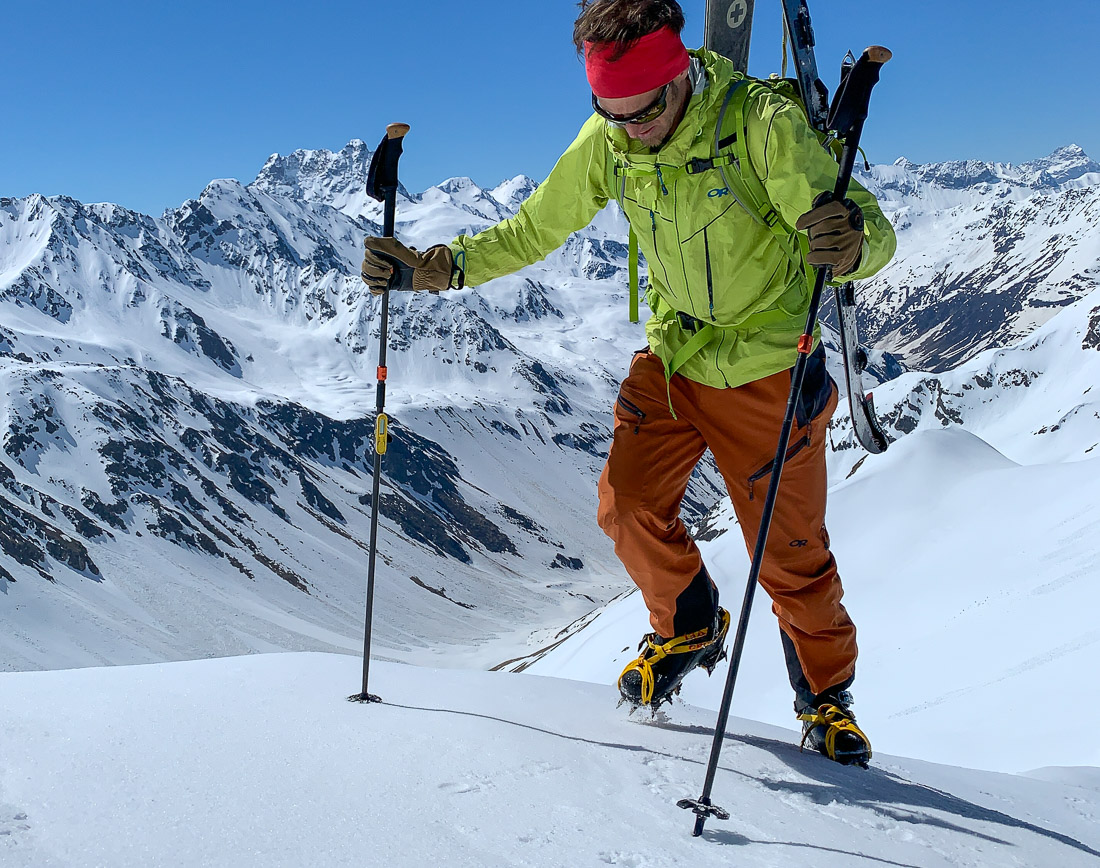
Crampons
In addition to normal snowboard boots, there are also special splitboard boots. These usually have a walk mode, less forward lean, and a mountain sole like mountain boots. Some are also crampon-compatible. On rock and ice, crampons are soon needed. Crampons hold great on touring ski boots. Unfortunately, not so much on normal snowboard boots. Even if there are special crampons for snowboard boots, like the Grivel G10. Splitboard boots are better, or even better, Hardboot splitboard boots. These are then crampon-compatible just like ski touring boots.
--> Read more about Hardboot Splitboarding
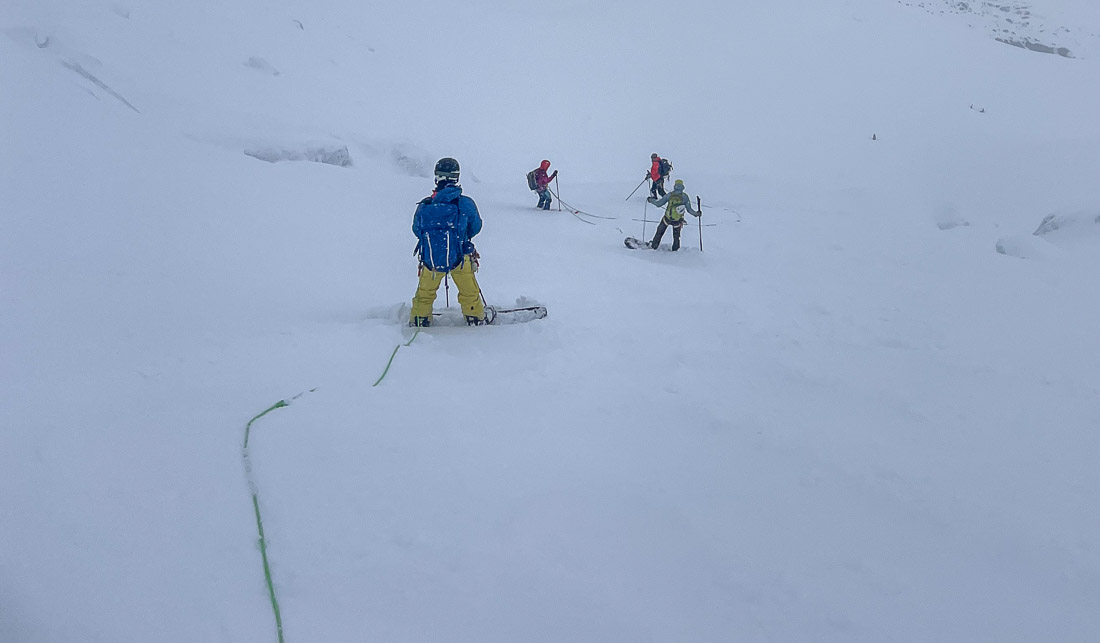
Riding with a Rope
Roping up is common on glaciers due to crevasses and the risk of slipping. On the ascent, the handling is the same as for ski tourers. On the descent, the snowboarder needs a bit more space to turn. Good riding skills and clear communication are important there. Poles for balance can help.
--> Read more about High-Altitude Touring with a Splitboard
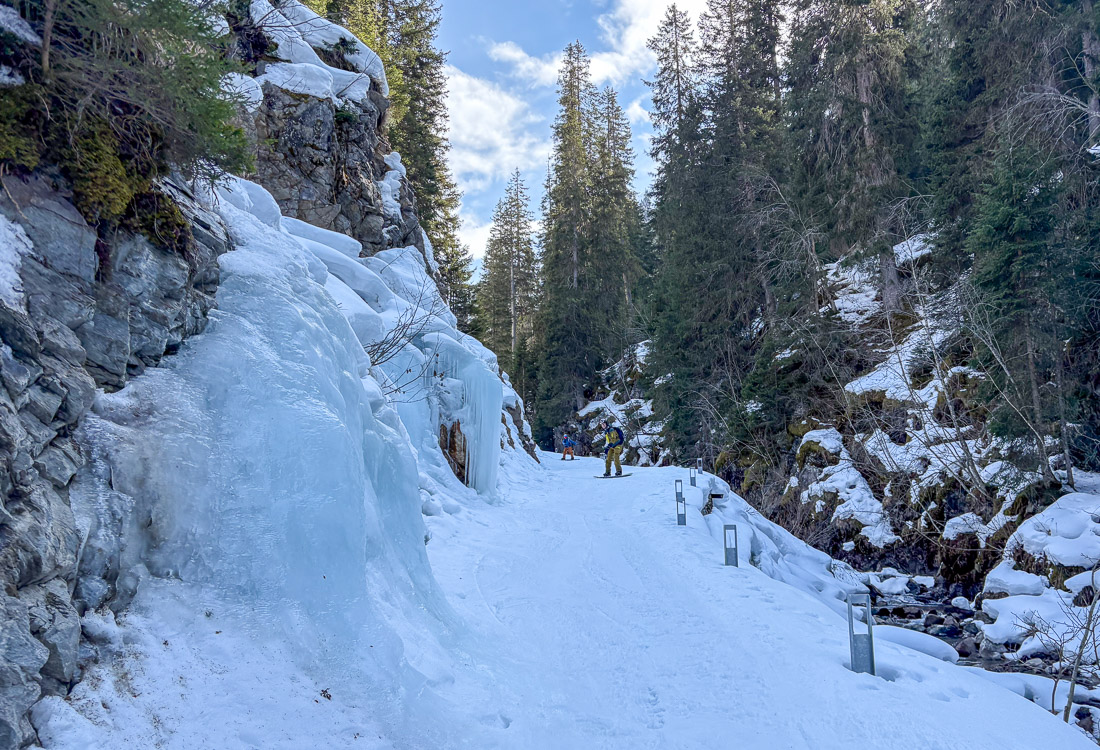
Icy and Narrow Passages
No boarder loves ice. Especially when it has already formed a narrow channel from skiers sliding. Navigating with only one edge is exhausting and difficult. Take breaks again and again and prefer to go on foot at critical points. But don't get the idea of sitting on the board and sliding down that way. That usually never ends well. The board slips away and ends up in the valley.
--> Read more about Suitable Beginner Tours
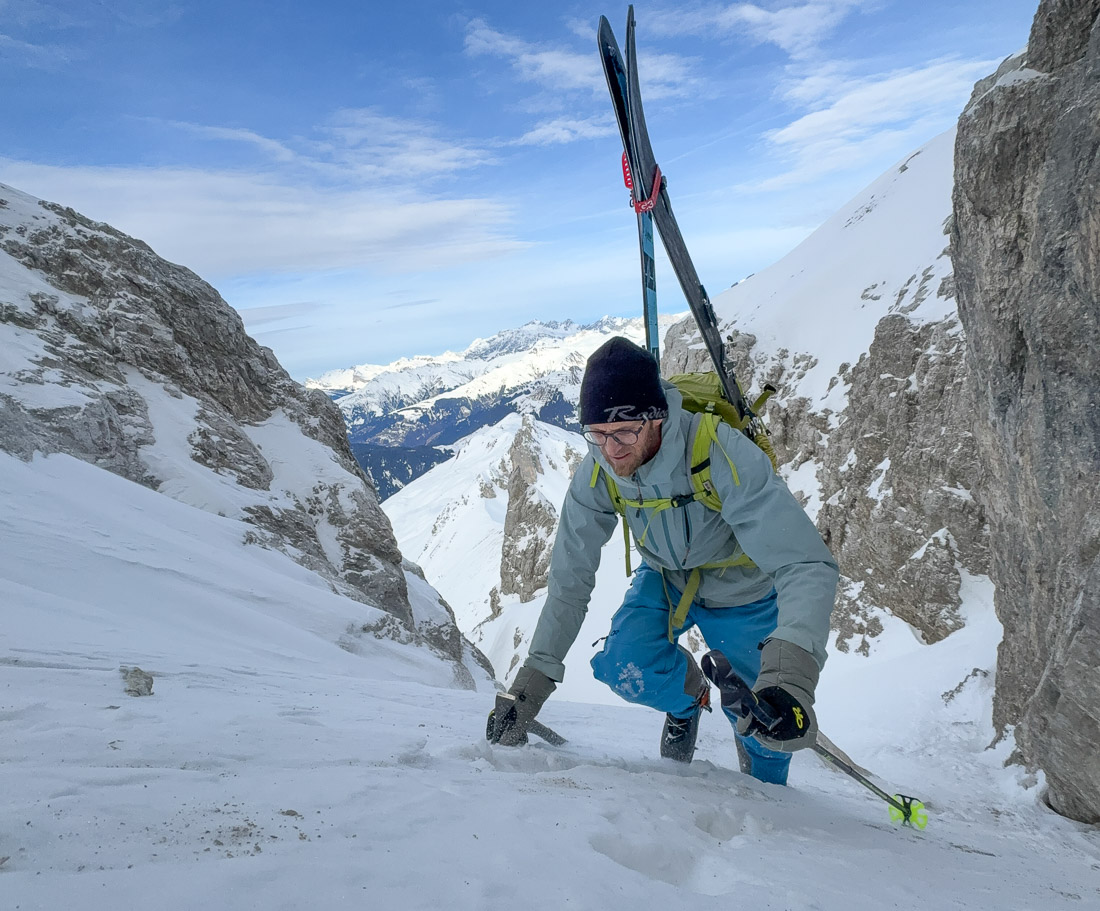
Securing Equipment
To attach the Splitboard, a backpack is needed that offers the width of the split board. Not all backpacks are suitable for splitboarders. Tying it together at the top helps so that there is enough space at the bottom to walk and the ski doesn't slip. Either secure the bindings with it, put them in the backpack, or hand them over. Because the Splitboard binding can easily fall off the board.
--> Read more about Outdoor Gear
Snow Types
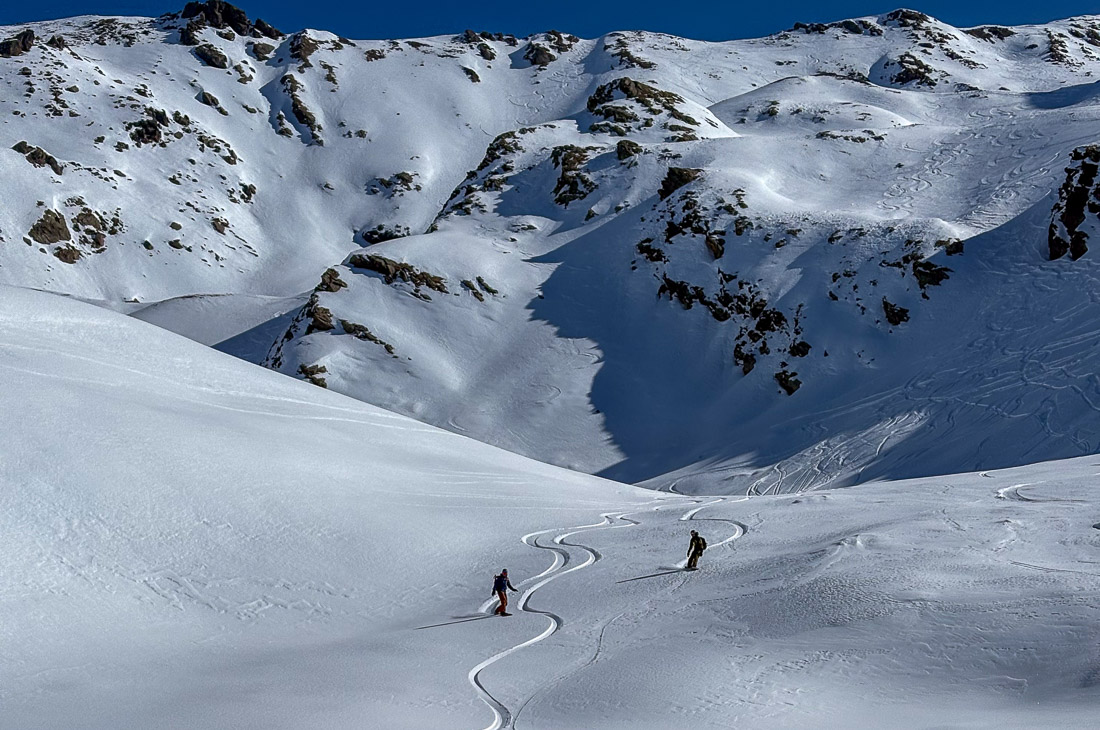
Everyone loves powder snow. Ideally only this type of snow on tours. Unfortunately, that's not always the case. Good snowboarders also cope with wet snow or breakable crust. For skiers, it's more of a nightmare. The shape of the board is important here. A fish shape with a long nose works quite well even in breakable crust.
--> Read more about Touring in Different Snow Types
How do you like our offer?
Are there tours, events, or courses that interest you or are missing? Have you noticed any improvements?
We look forward to your comment.


