
Radical Custom Boards:
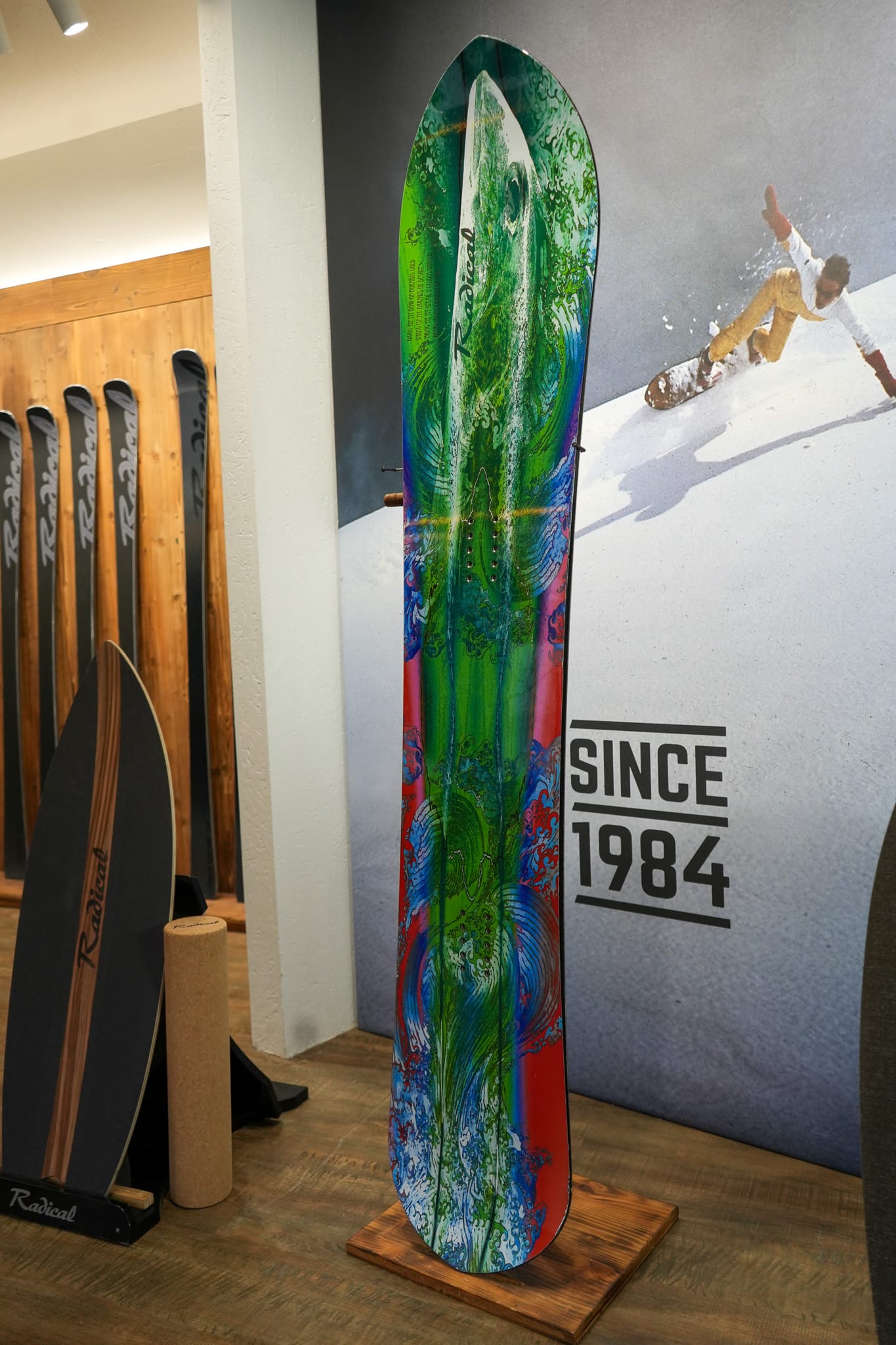
There are custom boards – and then there are those rare one-offs that are so much more than a snowboard. The board Dan MacGregor built together with Radical in 2009 belongs firmly in that second category. Dan now lives in Zurich, originally hails from northwest England, and has been inspired by art, nature, and perception since childhood. His work moves between structure and chaos, hand-drawing and digital technique. For him, a snowboard isn't just a piece of sports equipment, but a canvas in motion – a tool that draws lines in the snow the way a pen draws on paper.
The custom project with Radical grew out of a clear vision: a longer, more stable, more precise successor to the legendary Burton Fish – combined with Dan's own artistic signature. What came out of it is a snowboard that still leaves an impression today: his SuperFish 176cm.
A conversation about inspiration, shapes, art, and how a fish ended up on a scanner.
Interview with Dan
The following interview is originally in English. The German translation follows below.

"So, here it is - your masterpiece. When exactly did you create this design?"
We built the custom SuperFish 176 back in 2009. I wouldn't call it my masterpiece, though the board itself definitely is one. The shape was created by Radical founder Mark Farner, with input from me on how I wanted it to ride. Simon (Former Radical employee - Now founder of his own snowboard brand "super".) handled fabrication — the same shaper who'd already built another board I own, a super-light pure twin 160 with incredible pop. I actually learned to carve fakie on a steep black piste with that board, which completely changed my riding.
The artwork on the SuperFish is all mine, and it has its own story.
"Why did you choose to work with Radical?"
To explain that, I need to go back a little.
When I moved to Switzerland in 2002, I was introduced to snowboarding by a friend who gave me her old board — a Winterstick Mirror 148 (big thanks, Bettina). Way too small for me, but it got me started. That kicked off a progression through several boards: a GNU Altered Genetic 158, which I loved for its damp yet poppy feel until I snapped it, and then a Lib Tech Jamie Lynn 160 with Catek bindings — a directional freeride machine that let me carve as hard in soft boots as people did on plates.
I often rode with a friend, Tessy, who was always on a Radical raceboard. Watching her handle every condition, even deep snow, made an impression. In 2004, I found a prototype Burton Fish 156 HD with a plain white topsheet. I didn't realize what I'd stumbled upon, but the shape resonated with me immediately. Terje Haakonsen and Josh Gordon created something truly special. The Fish could ride everything, and in powder it felt like a dream. But it had limits - on icy traverses you could run out of tail fast, and the nose compressed easily at speed with aggressive technique.
Eventually, I realized what I wanted didn't exist: a longer, stiffer, more carving-oriented Fish that could handle all conditions — something fast, stable, and safe at high speed, with relentless edge hold.
Radical was the only company I trusted to take that idea seriously. I knew it wouldn't be cheap, but the vision was clear. When I met Mark Farner, his passion for crafting something unique sealed the deal. The rest is history.
"What was the main inspiration behind the graphic? We see nature, psychedelia, synthesizers, physics... is that accurate?"
It's spot on. My art revolves around the tension between structure and chaos — linear vs. non- linear, laminar vs. turbulent. I'm influenced by Japanese woodblock printing, especially Hokusai, as well as digital art, photography, and graphic culture. My process blends ink and paint with digital and AI techniques.
I think of drawing a line with a pen the same way I think of drawing a turn on the mountain. The metallic ink pen flexes with pressure, just as the snowboard flexes under force. The board becomes a kind of pen attached to your body - and the mountain becomes the canvas. It's wonderfully meta.
"Which boards inspired you in terms of shape or graphics?"
Absolutely, as I mentioned:
• The Radical raceboard Tessy rode — it proved Radical boards could handle anything.
• Jamie Lynn's Lib Tech — the harmony between the graphic and the ride was unforgettable.
• The Burton Fish — a true revolution in shape and versatility.
Back in 2009, true powder-focused shapes were still rare. The Prior Khyber existed, and the Dupraz shapes were there, but the scene looked nothing like today. Mark Farner was already exploring surf-inspired geometry years before it became mainstream - setback stances, tapered sidecuts, big shovels. He really is a pioneer.
"What is your background as an artist? Do you design other boards?"
I'm both an entrepreneur and an artist. Over the past decade, as co-founder of Nexxiot, I've focused on digital transformation in rail and maritime - reducing waste, improving accountability, and rethinking how the world manages and values its physical resources. In a way, that work has become its own form of art.
But the visual art has always continued. I have many ongoing projects, and I'd love to design more snowboards. There's something profoundly special about holding a board you've helped create - it's a functional sculpture, a high-performance canvas that itself comes to life on a vast canvas.
"Who was your favorite snowboarder back in the day? And who would you love to see riding this board today?
For me, Terje has always stood above the rest. I don't follow riders obsessively, but I appreciate styles in the context of their era. Nicolas Müller would absolutely rip this board — no doubt.
But the SuperFish isn't built for giant park tricks; it's built for powerful, fast, expressive lines. It loves natural features, tail steering, and blasting through windlips with huge sprays.
If I had to choose someone whose spirit matches the board, I'd say Marco Siffredi. He understood risk, embraced big mountains, and pushed limits with purpose. The short tail and stiff platform of the SuperFish thrive in that kind of steep, committed terrain. I wish he could have tried it.
"What's your absolute favorite detail in the artwork? We heard something about a fish and a photocopier..."
There are three main elements:
• Lightning "stringers" - digitally altered from a photo I took. Starting with a billion volts of nature feels like good quantum-karma.
• A wave inspired by Hokusai - a reminder of the hydrodynamic forces that shape the snowboard experience and the awesome power of nature in Hokusai's 'Great Wave'.
• A real red snapper - which I bought, placed on a flatbed scanner, and captured digitally. So yes... it's literally a fish cooked in lightning.
"How long have you been riding this board? Is it your daily driver or a powder-only tool?"
It's my number one board. I ride several others, but this one is my go-to on most days. My quiver includes a Prior Khyber 165, an Elevated Surf Craft 158 Whisky Jack, a Rad-Air Tanker, and a new Gentemstick Mantaray that I need to pick up in Japan.
"Any last thoughts? Where can people find your art?"
I'd recommend the custom-build experience to anyone. Having a board created around your taste, ambitions, and riding philosophy is genuinely special. If someone wants my art on a Radical board, I'm open to it. I'm not actively selling work right now, but I have some exciting new creative projects coming.
And I'm absolutely ready to design the next one together. Let's go... as soon as the season's over … 😉
Interview with German translation:
"So, here it is – your masterpiece. When exactly did you create this design?"
We built the custom SuperFish 176 back in 2009. I wouldn't call it my masterpiece, though the board itself definitely is one. The shape was developed by Radical founder Mark Farner, with input from me on how I wanted it to ride. Simon (Former Radical workshop manager - Now founder of his own snowboard brand "super".) took care of the fabrication – the same shaper who had already built another board I own, a super-light pure twin 160 with incredible pop. I actually learned to carve fakie on a steep black piste with that board, which completely changed my riding.
The artwork on the SuperFish is entirely mine – and it has its own story.
"Why did you decide to work with Radical?"
To explain that, I need to go back a little.
When I moved to Switzerland in 2002, I was introduced to snowboarding by a friend who gave me her old board – a Winterstick Mirror 148 (big thanks, Bettina). Way too small for me, but it got me onto a snowboard in the first place. That led to a series of other boards: a GNU Altered Genetic 158, which I loved for its damp yet still poppy feel until I broke it, and after that a Lib Tech Jamie Lynn 160 with Catek bindings – a directional freeride machine that let me carve as hard in soft boots as others did on plates.
I often rode with a friend, Tessy, who always rode a Radical raceboard. Watching her master every condition – even deep snow – made an impression. In 2004, I then found a prototype Burton Fish 156 HD with a completely white topsheet. At the time I didn't know what I had in my hands, but the shape resonated with me immediately. Terje Haakonsen and Josh Gordon had created something truly special. The Fish could ride anything, and in powder it felt like a dream. But it had its limits – on icy traverses you could quickly run short on tail, and the nose compressed fairly easily at high speed with aggressive technique.
At some point it became clear to me that what I wanted didn't exist: a longer, stiffer Fish built more for carving, that could master all conditions – fast, stable, and safe at high speed, with unshakeable edge grip.
Radical was the only company I trusted to really take that idea seriously. I knew it wouldn't be cheap, but the vision was clear. When I met Mark Farner, his passion for creating something unique convinced me. The rest is history.
"What was the main inspiration behind the graphic design? We see nature, psychedelia, synthesizers, physics... is that accurate?"
Exactly. My art revolves around the tension between structure and chaos – linear vs. non-linear, laminar vs. turbulent. I'm inspired by Japanese woodblock prints, especially Hokusai, but also by digital art, photography, and graphic culture. My process combines ink and paint with digital and AI-based techniques.
I think about drawing a line with a pen in the same way I think about drawing a line down the mountain. The metallic ink pen bends under pressure, just as the snowboard bends under force. The board becomes a kind of pen connected to your body – and the mountain becomes the canvas. Nicely meta.
"Which boards inspired you in terms of shape or graphics?"
Definitely, as already mentioned:
• The Radical raceboard that Tessy rode – it showed that Radical boards could master anything.
• Jamie Lynn's Lib Tech – the harmony between graphic and ride feel was unforgettable.
• The Burton Fish – a true revolution in terms of shape and versatility.
In 2009, truly powder-native shapes were still rare. The Prior Khyber existed, and the Dupraz shapes were around, but the scene looked completely different than it does today. Mark Farner had already been exploring surf-inspired geometries years earlier – setback stances, tapered sidecuts, big shovels. He really is a pioneer.
"What is your artistic background? Do you also design other boards?"
I'm both an entrepreneur and an artist. Over the past ten years, as co-founder of Nexxiot, I've focused on digital transformation in rail and maritime shipping – reducing waste, increasing transparency, and rethinking how the world manages and values physical resources. In a way, that work has also become a form of art.
But the visual art has always been present. I have many ongoing projects and would really love to design more snowboards. There's something deeply special about holding a board in your hands that you helped create yourself – it's a functional sculpture, a high-performance canvas that itself comes to life on a huge canvas.
"Who was your favorite snowboarder back in the day? And who would you love to see on this board today?"
For me, Terje always stood above everyone else. I don't follow riders obsessively, but I appreciate styles in the context of their time. Nicolas Müller would absolutely destroy this board – no doubt about it.
But the SuperFish isn't built for big park tricks; it's made for powerful, fast, expressive lines. It loves natural features, tail steering, and blasting through windlips with huge sprays.
If I had to choose someone whose spirit matches the board, it would be Marco Siffredi. He understood risk, loved big mountains, and pushed limits with purpose. The short tail and stiff platform of the SuperFish really thrive in that kind of steep, committed terrain. I wish he could have ridden it.
"What's your absolute favorite detail in the artwork? We heard something about a fish and a photocopier..."
There are three main elements:
• Lightning "stringers" – digitally altered from a photo I took. Starting with a billion volts of nature feels like good quantum karma.
• A wave inspired by Hokusai – a reminder of the hydrodynamic forces that shape the snowboarding experience, and of the immense power of nature in Hokusai's "Great Wave."
• A real red snapper – which I bought, placed on a flatbed scanner, and captured digitally. So yes... it's literally a fish, cooked in lightning.
"How long have you been riding this board? Is it your daily driver or purely a powder board?"
It's my number one board. I ride several others, but this is my go-to on most days. My quiver includes a Prior Khyber 165, an Elevated Surf Craft 158 Whisky Jack, a Rad-Air Tanker, and a new Gentemstick Mantaray that I still need to pick up in Japan.
"Any closing thoughts? And where can people find your art?"
I'd recommend the custom-build experience to anyone. Having a board built around your own taste, ambitions, and riding philosophy is genuinely something special. If someone wants my art on a Radical board, I'm open to it. I'm not actively selling pieces right now, but I have a few exciting new creative projects in the works.
And I'm absolutely ready to design the next board together. Let's do it… as soon as the season's over. 😉
Closing Note
Thank you for taking the time to dive into this special story. Projects like these remind us why we build snowboards: because every board creates a connection – between people, ideas, and moments on the mountain.
A huge thank you to Dan for his openness, his art, and for sharing this one-of-a-kind board with us.
If you'd like to bring a Custom Project of your own to life with us, we'd love to accompany you on that journey. The best always happens together.


Learn more about our Custom Mades.


